
When you walk into a grocery store and pick up a bag of edamame or a pack of soy-based products, you’re seeing the end of a long journey: one that starts in the field and ends with decisions made by farmers, extension agents, and scientists. One of the biggest threats along that chain? A fungal disease known as Cercospora Leaf Blight (CLB).
In the Southern United States, this disease has been punching above its weight: it spreads in late season soybeans, under hot, humid conditions, and it can slip past fungicides that once reliably kept it in check. According to recent surveys, a startling 64–83% of CLB pathogen isolates were found to be resistant to the commonly used quinone outside inhibitor (QoI) class of fungicides.
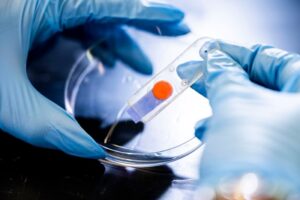
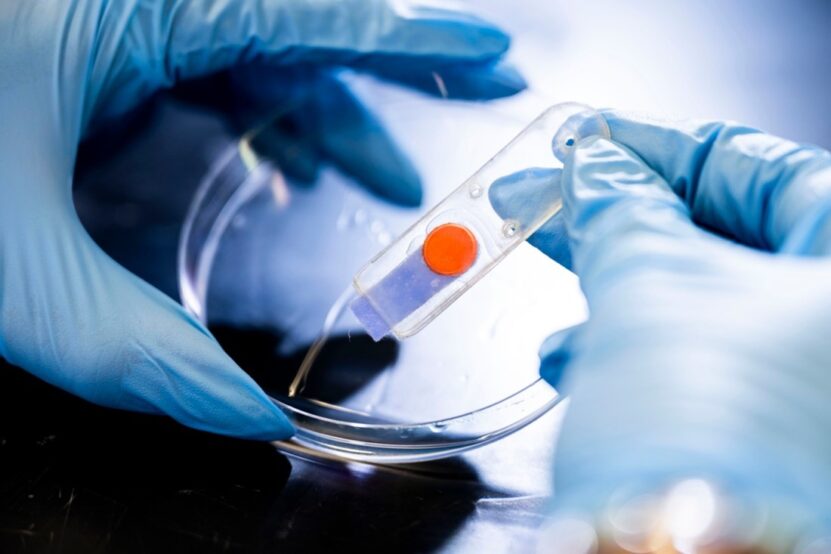
At the LSU AgCenter, researchers are testing a loop-mediated isothermal amplification (LAM) diagnostic tool, adapted from work in sugar beet crops, which uses a simple color change to indicate whether a fungicide is still effective by determining if the pathogens have evolved resistance.
Think of it like a litmus paper test: pink = safe, yellow = caution. If the test flips color from pink to yellow, you might save hundreds or thousands of dollars by avoiding fungicide applications that won’t work.
Why It Matters
As a farmer you’ve budgeted thousands of dollars for fungicide applications. You go out at the calendar-recommended time, you apply, but the crop is still devastated by disease. Why? Because the pathogen changed, the fungicide stopped working or the wrong fungicide was used.
This color test gives immediate and tangible feedback. Instead of spraying “just in case,” you can get an answer to the question, “Do I need to spray with this fungicide?” If the test stays pink, you proceed. If it turns yellow, you reconsider. This kind of decision tool puts power in the hands of the farmer, saves money, and reduces unnecessary chemical use helping both the wallet and the environment.
How The Science Works
Behind that simple color shift is molecular biology: the LAMP test uses DNA from the pathogen to detect whether the strain carries the resistance mutation (for example, the G143A substitution associated with QoI resistance). The color-change result is visible to the naked eye, no fancy machine. It’s still lab-verified at this stage (not a full field kit yet), but it can deliver results in a day rather than weeks.
And it’s fast. In another example of LAMP applications, a 2025 study developed a color-change test for soybean root pathogen detection with a detection limit two orders of magnitude better than older methods (PubMed).
What This Will Mean for Growers
Here are practical takeaways:
- Test before you spray: Fungicide sprays are being challenged by resistant pathogens. This new test will allow informed decision-making.
- Save money: If the test shows the fungicide won’t work, you avoid the cost of applying fungicides and can rethink strategy (rotation, different mode-of-action, other practices).
- Reduce unnecessary chemical use: That’s good for the bottom line and for the environment, aligning with sustainable practices that are being increasingly adopted.
And here’s how it helps your customer: Smarter solutions mean healthier crops, fewer chemical residues, and potentially lower input costs that help keep food prices stable. So, when the soybeans get made into tofu, edamame, or animal feed, the supply chain is stronger.
What’s Next and Why It Matters

- Proven in the lab, heading to the field: Early trials have delivered promising results, and researchers are now gearing up for real-world deployment.
- Partnerships will make it happen: Success depends on growers, extension services, labs, and manufacturers working in sync to pilot, validate, and scale the test.
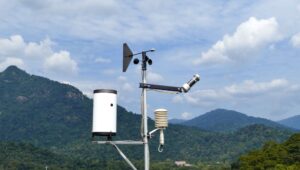
- Data is fuelling the model: The team is layering fungicide-resistance data, spore-trap monitoring, and weather modelling to pinpoint exactly when and where disease risks surge.
We’re moving from reactive to proactive disease management. It’s a big leap, especially since resistance can be detected even in fields that haven’t used the same fungicide class before (PubMed).
If you’re planting soybeans, especially in the mid-South, keep this on your radar. A simple color shift could soon serve as your resistance detection system.
In the meantime, diversify your defenses: plant resistant varieties, rotate crops, scout often, and avoid “spray just in case.” Keep asking the question, “Will this fungicide work?”
Because when the test turns yellow, it’s time to rethink, and when it stays pink, you’re protecting both your crop and your bottom line.
About the Authors
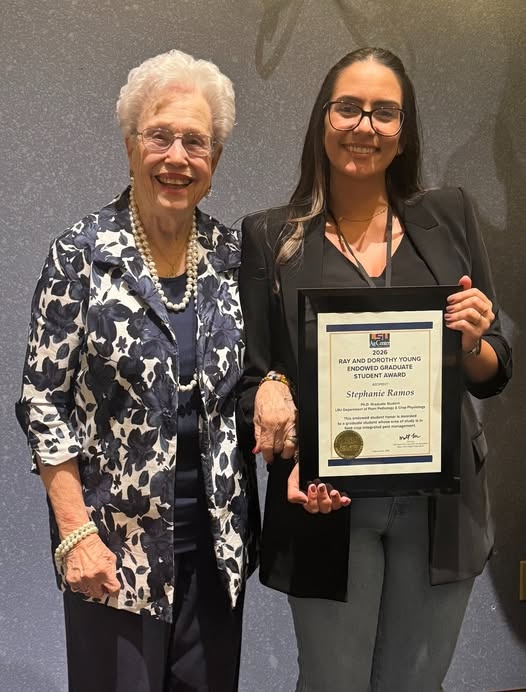
Stephanie Ramos is a Ph.D. student in Plant Pathology at Louisiana State University (LSU) and a member of The American Phytopathological Society (APS). Originally from Brazil, she holds a bachelor’s degree in Agricultural Sciences from the Federal University of São Carlos (UFSCar) and a master’s degree in Plant Pathology from LSU.
Her research focuses on the epidemiology and management of Cercospora leaf blight of soybean in the southern United States. She is passionate about science communication, leadership, and outreach initiatives that connect plant pathology research with growers and local communities.
Dr. Sara Thomas-Sharma is an Associate Professor in the Department of Plant Pathology and Crop Physiology at the LSU AgCenter, Baton Rouge, LA. She is a field crop pathologist with research focused primarily on diseases of soybean.
Her research program has focused on better understanding the epidemiology and management of Cercospora leaf blight, and Aerial blight, two economically important diseases for soybean growers in Louisiana.
Originally from India, she joined APS in 2007 while a graduate student at the University of Georgia. An active member, she most recently served with the APS Office of International Programs.
This article is part of the APS Outreach Project, an initiative of The American Phytopathological Society (APS). APS is a nonprofit professional organization with over 3,600 scientists dedicated to advancing global plant health.
Representing academia, government, industry, and private practice, APS members drive innovation in the accuracy and speed of field disease diagnostics and deepen our understanding of plant pathology through fundamental research.
APS publishes peer-reviewed, reliable information in its scientific journals and translates research into actionable solutions for growers through the APS Outreach Project and Grow: Plant Health Exchange® (planthealthexchange.org), a knowledge base for plant health management professionals.