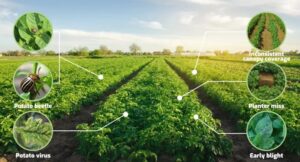
Resistance to fungicides and antibiotics needed to suppress plant pathogens, regulatory restrictions on the uses of a dwindling number of compounds, and public pressure to reduce use of all pesticide use have profoundly reduced the disease management options available for sustainable production of a broad array of crops.
Germicidal ultraviolet light (UV-C) offers a residue-free, non-chemical approach that suppresses key diseases, integrates into organic systems, and crucially supplements existing chemistries. Pioneering work in grapes, apples, strawberries, tomatoes, cucurbits, and beets has conclusively demonstrated efficacy in comprehensive programs, at scale, in commercial agricultural systems.
The need for and suppression of pathogens and low environmental impact
In the era since the publication since Silent Spring, pesticides have fundamentally changed, and in most ways for the better. Modern fungicides are a world apart from the broad-spectrum materials that were once used, and they are carefully selected for their specificity towards target pathogens.
But this specificity comes with a cost: it makes it very easy for pathogens to develop resistance. To sustainably feed a growing population, we desperately need methods to supplement and preserve the tools that remain. In the case of newly imported pathogens, we may not yet have the tools to prevent their destructive spread.
Where does UV-C fit in sustainable agricultural systems?
The shortest wavelengths of natural solar ultraviolet light impact the DNA of all living organisms in much the same manner: they cause a chemical bonding of a component of the DNA molecule. That bonding garbles vital instructions in the genetic code and can be lethal if not repaired.
Most living organisms have natural biochemical mechanisms that can fix this damage. Microbial pathogens evolved their own such mechanisms to repair this UV-inflicted damage to their DNA.
It’s called a “photolyase” repair system, and it uses blue light from the sun to drive the repair of DNA. That’s a remarkable trick for the microbe. They have co-opted one portion of the solar spectrum and use it to repair damage inflicted by another.
Solar UV arrives simultaneously with blue light, and the blue light drives the repair UV-inflicted damaged of DNA. Because it is blue-light driven, the DNA repair system shuts down at night. After all, why run a DNA repair mechanism 24/7 when UV is only a threat during daylight?
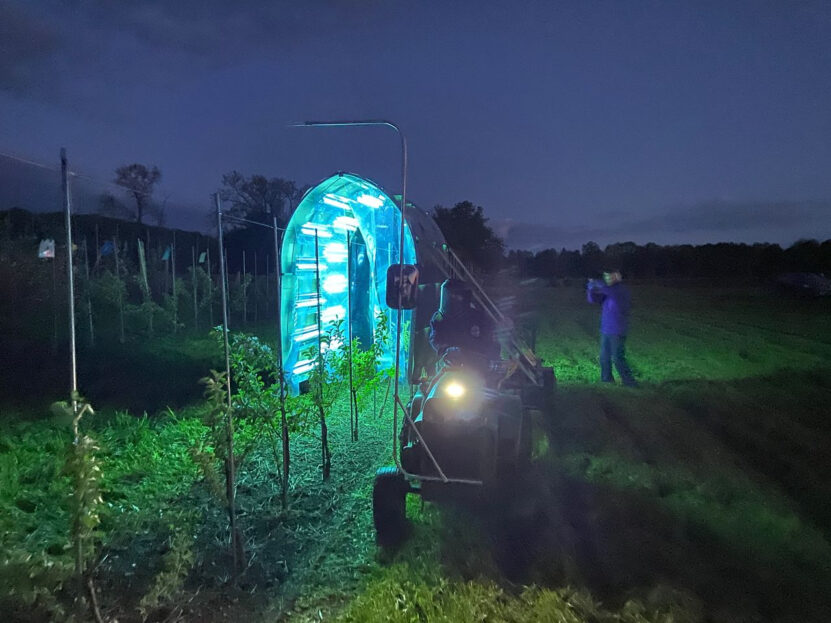
And that is secret to using germicidal UV (short-wave UV-C) against a pathogen: we apply it at night: no blue light, no repair of the UV-damaged DNA, and the pathogens die. (Introductory explainer via the Small Fruits Consortium; additional Cornell background on night operations and robotics.) Small Fruits Consortium explainer
Such antimicrobial uses of UV-C are not speculative: germicidal ultraviolet (GUV) has a decades-long safety/engineering record in air, water and surface disinfection when used properly. What is new is the nighttime use of UV to selectively suppress pathogens in diverse crop production systems
What the data show (by crop)
Strawberries. Weekly nighttime applications of UV-C at 70 to 200 J/m2 have provided control of strawberry powdery mildew. This is THE major constraint on strawberry production in glasshouses, high tunnels, and urban plant factories, which are necessary production system (as opposed to open fields) in many areas.
UV-C is now used commercially on over 20% of the strawberry acreage in the UK and being used by some of the largest strawberry producers (Driscolls in CA and Fancy Farms in FL) on both coasts of the US.
Cucurbits. Powdery mildew (PM): Peer-reviewed cucumber studies report that night-time UV-C at approximately 72–144 J·m⁻², applied nightly or 1–2× per week, reduces disease severity; in several programs, UV-C + fungicide performed best, helping preserve chemistry over time.
Table beets (Cercospora leaf spot, CLS). A Cornell-led, peer-reviewed study demonstrates that night-time UV-C suppressed CLS across lab, greenhouse, and field settings. At effective doses, transient leaf speckling occurred but plants recovered—indicating an operational window with careful calibration. (Cornell study summary; Plant Disease paper.)
Grapes. Field trials in Chardonnay show ~100–200 J·m⁻² once weekly at night provided suppression of powdery mildew on leaves and fruit across low- and high-pressure seasons, without measured yield or quality penalties.
Suppression of sour rot, a complex of fungi, bacteria, and insects, was suppressed by UV-C to a level that equalled the best available chemical treatments. Suppression of downy mildew was less robust but still provided a nearly 75% reduction of disease on hybrid grape varieties with moderate disease resistance. SAGA robotics now treats over 1200 acres of premium wine grapes in the Paso Robles region of CA.
Apples. UV-C works to suppress bacterial as well as fungal plant pathogens. Fireblight is a nightmarish disease that is particularly severe in high-density apple plantings. Cornell reports that UV-C provided control of fire blight (Erwinia amylovora) to a degree that exceeded that provided by antibiotics.
This was a breakthrough given the long-running scrutiny of agricultural antibiotic use and the removal of antibiotics from U.S. organic fruit production.
The most recent Cornell studies have demonstrated significant suppression of the apple scab pathogen (Venturia inaequlis). Like the beet pathogen Cercospora beticola, V. inaequalis is heavily melanized. One might think that such fungi might be less susceptible to UV-C. The apple scab pathogen also resides beneath the waxy cuticle of apple leaves and fruit.
Despite the purported advantages of such a niche being less accessible to UV-C, nighttime applications have now provided control of apple scab that compares well to many of the best fungicides now in use.
What about bugs? UV-C is very effective in killing the eggs and immature stages of mites on strawberries, and they are now controlled in many glasshouse production systems in the Netherlands and elsewhere.
Is UV-C technology sufficiently advanced that it can provide commercially relevant suppression of multiple plant pathogens at scale?
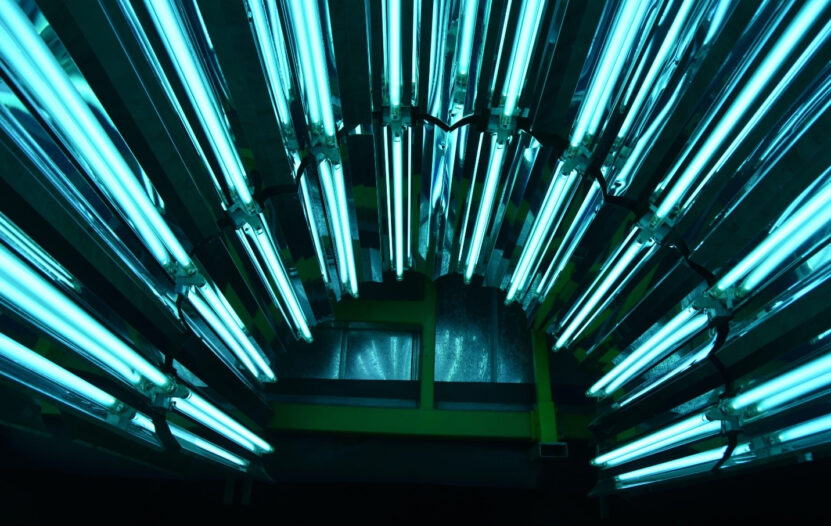
Absolutely! One company in the Netherlands (Cleanlight) has been producing static UV arrays for glasshouses, as well as mobile arrays for glasshouse and field use since 2005.
Another company (Saga Robotics) now uses autonomous robotic arrays to treat over 20% of the strawberry acreage in the UK.
SAGA Robotics has deployed a fleet of autonomous UV-C robots to treat over 1200 acres of winegrapes near Paso Robles, CA; with plans to expand to 4000 acres in 2026. There are several start-up companies now in countries around the world that are producing diverse devices to treat a broad range of crops (Tric Robotics, UV Boosting, Octivia, and Advanced Intelligent Systems).
About the author:
David M. Gadoury is a plant pathologist and senior research associate emeritus at Cornell University’s Geneva campus: Cornell AgriTech, and an adjunct faculty member of the Plant Pathology Department of the University of Florida.
He is known for his fundamental and applied work on the epidemiology and management of diseases of high-value fruit crops, particularly grapes, strawberries, and apples.
He is a fellow of the American Phytopathological Society, served the society as their Internal Communications Officer, chaired the APS Foundation (the charitable arm of the society), and hosted season 1 of their popular podcast Plantopia.
A recurring theme in his work has been how microbial pathogens interact with light (both visible and UV), and how this can be used for practical disease management.